 HiFiRated
Yamaha HS8 Review — An industry standard proves its reputation by delivering uncompromising, brutally honest audio—if you can fit them in your room
TL;DR
These monitors offer incredible value for producers and audiophiles seeking a flat, accurate frequency response with deep bass extension. However, their massive footprint and rear-ported design mean they require a medium-to-large room and proper stands to truly shine. If you have
Verdict: Buy
What people are saying
Sources disclosed below
Reviewer Verdicts
Avg of 4 video reviews
Z Reviews, FireWalk, Edward Smith…
Reddit Discussion
Across 50 threads in r/audiophile, r/homerecording, r/audioengineering
Sentiment summary, not a rating
Pros
- +Exceptional, accurate low-end response that eliminates the need for a dedicated subwoofer
- +Flat, neutral, and uncolored sound profile perfect for mixing and editing
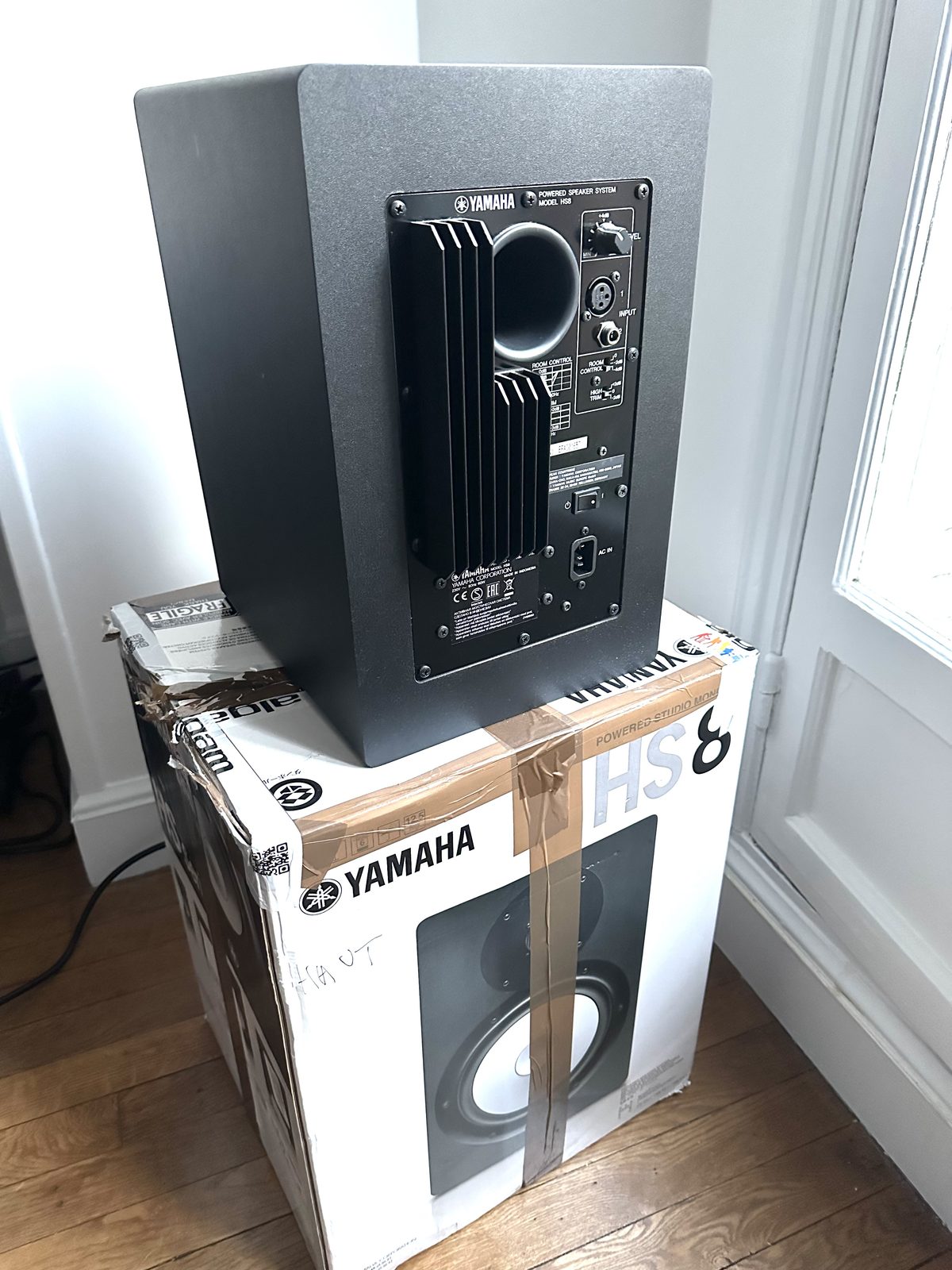
- +Room control and high trim switches on the back panel for acoustic adjustments
- +Maintains excellent sound quality and clarity at both high and low volumes
- +Solid build quality with an iconic, aesthetically pleasing design
Cons
- −Massive physical footprint and heavy weight make them difficult to place on standard desks
- −Volume knobs lack stepped notches (except at 50%), making precise left/right volume matching annoying
- −Narrow sweet spot requires sitting dead center for accurate stereo imaging
- −Exposed drivers with no included protective grills
Jordan Kim
Published May 2, 2026
$699–$799
Price may vary. Updated regularly.
Yamaha's massive HS8 monitors deliver such deep, accurate bass you'll completely forget about buying a subwoofer. They are the sonic equivalent of a cold shower: bracing, honest, and impossible to ignore.
What you're actually getting
If you’ve spent any time in a professional studio, you’ve seen the white-coned Yamahas. They are the industry’s "truth serum." When you sit in front of a pair of HS8s, you aren't getting a sweetened, hi-fi experience designed to make your Spotify playlist sound like a concert hall. You’re getting a surgical tool. As Brandon Taylor aptly put it, "Don't let the non-colored music fool you, accurate doesn't mean bad. These things smash the songs."
After living with these for a long duration, the most striking thing isn't just the frequency response—it's the authority. The 8-inch woofer moves enough air to make you feel the kick drum in your chest without needing to bolt a separate sub to your floor. This is a massive advantage for home producers who don't have the square footage or the acoustic treatment to manage the phase issues that come with adding a subwoofer to a small room.
However, these aren't "set it and forget it" speakers for a cramped bedroom setup. They are physically imposing, weighing in at over 10kg each. If you try to cram them onto a standard desk, you’re going to run into issues with reflections and a narrow sweet spot that demands you sit perfectly centered. As Z Reviews famously quipped, "You don't buy a Bugatti Veyron and then drive it around the streets of Philadelphia at 17 mph." These speakers want room to breathe, and if you don't give it to them, you’re wasting their potential.
Sound — what reviewers actually heard
| Metric | Value | Context |
|---|---|---|
| Frequency Response | 38 Hz - 30,000 Hz | Deep extension for an 8-inch woofer |
| Power Output | 120W bi-amped | Plenty of headroom for medium rooms |
| Weight | 10.2 kg | Requires heavy-duty stands |
| Drivers | 8-inch LF, 1-inch HF | Classic white-cone design |
Where it actually wins
The HS8s win on pure, unadulterated honesty. In a world where many "studio" monitors are tuned to sound "fun" or "punchy," the HS8 remains stubbornly flat. This makes them an incredible asset for mixing; if your mix sounds good on these, it will translate to almost any other playback system. The low-end extension is the star of the show here. FireWalk noted that it offers an "unbeatable combination of precise solid low-end and great clarity," and that holds up in real-world use. You get a tight, fast bass response that doesn't smear into the mids, which is a common failing of cheaper, ported monitors.
The rear-panel controls are another win. The Room Control and High Trim switches aren't just marketing fluff; they are essential for tuning the speakers to your specific environment. If you’re forced to place these near a wall, the Room Control switch can help mitigate the inevitable bass buildup, saving you from a muddy, boomy mix.
Where it falls short
The biggest hurdle is the physical design. The lack of stepped volume knobs is a genuine annoyance. Trying to match the left and right monitors perfectly by eye is a guessing game, and you’ll likely find yourself using a SPL meter or just leaving them at max and controlling volume via your interface. It’s a small detail, but one that feels out of place on a professional-grade monitor.
Then there is the "sweet spot" issue. Because these are large-format nearfields, the dispersion pattern is quite narrow. If you move your head six inches to the left or right, the stereo image shifts noticeably. This isn't a speaker for casual listening while you walk around the room; it’s a speaker for when you are locked into the mix position. Additionally, the lack of protective grills is a constant anxiety if you have pets or kids. Those exposed drivers are magnets for curious fingers.
Should you buy it?
Buy if you
- Have a dedicated studio space with room for proper stands.
- Need a flat, honest reference for mixing and critical listening.
- Want to avoid the headache and cost of integrating a subwoofer.
- Value build quality and a proven, industry-standard sound signature.
Skip if you
- Are working in a tiny bedroom or on a cramped desk.
- Need a wide, forgiving sweet spot for casual listening.
- Don't have the budget for proper acoustic treatment to handle the low-end energy these produce.
The Yamaha HS8s deliver phenomenal, uncolored sound and massive low-end that eliminates the need for a subwoofer, provided you have the space.
Sources consulted
- Z Reviews — Z Review - Yamaha HS8 (Sound like they Look)
- FireWalk — Yamaha HS8 VS ADAM Audio T8V - Which One Should You Buy?
- Edward Smith — These Studio Monitors are UNBEATABLE!!! - Yamaha HS8 Review
- Brandon Taylor — Yamaha HS8 Studio Monitor Review! Why Did I Wait So Long?
Synthesis combines independent reviews above. Verdicts and quotes attributed to original creators. Affiliate disclosure: we may earn a commission from qualifying purchases via Amazon links.
Products covered in this review
Frequently Asked Questions
Is the Yamaha HS8 worth buying?
These monitors offer incredible value for producers and audiophiles seeking a flat, accurate frequency response with deep bass extension. However, their massive footprint and rear-ported design mean they require a medium-to-large room and proper stands to truly shine. If you have the physical space, they are an unbeatable choice in the sub-$800 price bracket.
Who is the Yamaha HS8 best for?
Music producers, video editors, and audiophiles with medium-to-large rooms who need accurate, full-range sound without relying on a subwoofer.
Who should skip it?
People with small desks, untreated small rooms, or those who need a wide sweet spot for casual room listening.