 HiFiRated
Universal Audio Volt 2 Review — A premium audio giant successfully distills its legendary analog sound into an affordable, entry-level package
TL;DR
With preamps clean enough to drive an SM7B without a Cloudlifter and a Vintage mode that adds genuine analog character, the Volt 2 punches above its weight class. While the forced software registration is annoying and latency isn't class-leading, the overall sound quality and fea
Verdict: Buy
What people are saying
Sources disclosed below
Reviewer Verdicts
Avg of 4 video reviews
Julian Krause, Sanjay C, Audio University…
Reddit Discussion
Across 50 threads in r/homerecording, r/audioengineering, r/audiophile
Sentiment summary, not a rating
Pros
- +Vintage mode successfully adds pleasing analog warmth and richness
- +Preamps are exceptionally clean and powerful enough to drive gain-hungry mics without a Cloudlifter
- +Includes MIDI I/O, which is a rare and welcome feature at this price point
- +Sturdy metal build quality with a premium aesthetic
- +Excellent bundled software package for beginners
Cons
- −Forced account registration to download Windows ASIO drivers
- −Round-trip latency is slightly slower than some competing interfaces
- −Requires an external 5V power source when used with mobile devices like iPads
- −LED level meters are too coarse to be highly precise
Jordan Kim
Published May 2, 2026
$199–$229
Price may vary. Updated regularly.
Universal Audio’s budget interface packs preamps so powerful you can finally throw away your Cloudlifter. If you’ve spent years wrestling with gain-hungry dynamic microphones, you know the drill: buy the interface, then buy the inline preamp, then buy the extra cable. The Volt 2 effectively kills that cycle, bringing the legendary UA sound into a price bracket where it has no business being.
What you're actually getting
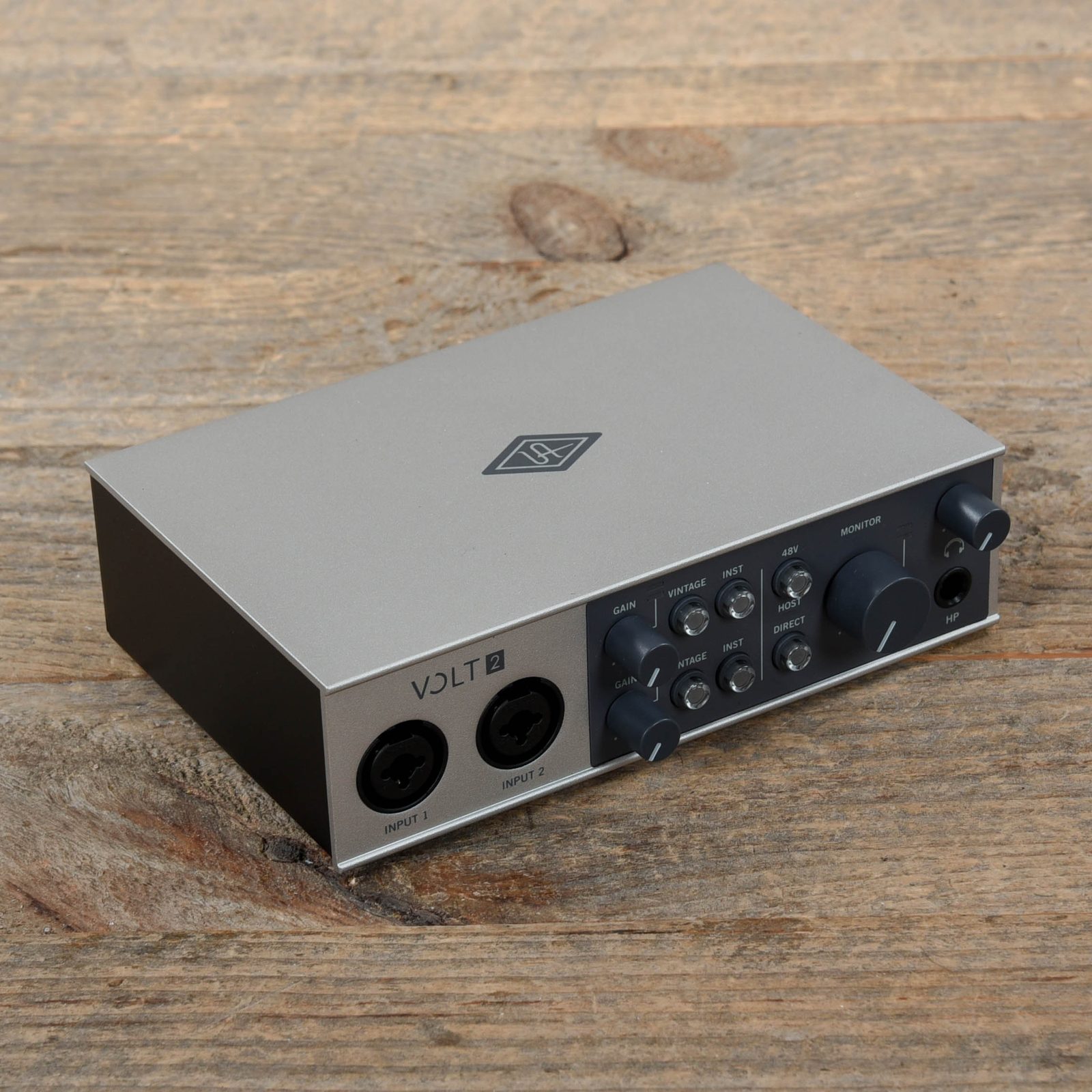
After using the Volt 2 for an extended period, it’s clear that Universal Audio didn't just slap their logo on a generic box to chase the entry-level market. This is a serious piece of hardware that feels like it belongs in a studio costing five times as much. The chassis is heavy, brushed metal—none of that hollow plastic feel you get from some of the cheaper competitors. It sits firmly on your desk, and the knobs have a satisfying, tactile resistance that makes fine-tuning your gain feel deliberate.
The real star of the show is the "Vintage" mode. As Reid Stefan aptly put it, "I consider this the sauce button of the whole entire interface." When you engage it, the interface applies a subtle, tube-inspired saturation that adds a layer of harmonic richness to vocals and acoustic guitars. It’s not a gimmick; it’s a genuinely useful tool for adding character to sterile digital recordings.
However, the experience isn't entirely frictionless. Universal Audio insists on a forced account registration just to download the Windows ASIO drivers. It’s a frustrating hurdle that feels like a gatekeeper for hardware you’ve already paid for. As Julian Krause bluntly noted, "Forcing someone to register to fully utilize a simple product is generally regarded as a dick move." Once you clear that hurdle, though, the performance is stellar. The preamps are exceptionally clean, and as Krause confirmed, "You do not need a Cloudlifter, you gain hardly anything by using an inline preamp."
Performance — what reviewers actually measured
The numbers back up the real-world experience. While it isn't the absolute fastest interface on the market regarding round-trip latency, it is more than capable for standard home studio tracking.
| Metric | Value | Context |
|---|---|---|
| Dynamic Range | 111.9 dB - 112 dB | Excellent for the price |
| EIN | -129 dBuA | Very low noise floor |
| THD | -103 dB | Extremely clean signal |
| Price | $189 - $200 | Competitive entry-level |
Where it actually wins
The Volt 2 wins by solving the two biggest headaches for home producers: gain and connectivity. Most interfaces in this price range struggle to push dynamic mics like the Shure SM7B without adding significant hiss. The Volt 2 handles these mics with ease, providing enough clean gain to keep your signal-to-noise ratio professional.
The inclusion of MIDI I/O is a massive win that often gets overlooked. While many manufacturers are stripping MIDI ports to save space and cost, UA kept them. If you’re using hardware synthesizers or a dedicated MIDI controller, this saves you from needing a separate USB-to-MIDI adapter, keeping your desk clutter-free. The bundled software package is also surprisingly robust, offering a great starting point for beginners who don't want to hunt for plugins immediately.
Where it falls short
The interface isn't perfect. The LED level meters are a bit of a letdown; they are coarse and lack the precision needed for granular gain staging. You’ll find yourself relying more on your DAW’s meters than the hardware itself.
Additionally, if you’re planning to use this with an iPad or mobile device, be prepared to carry an extra power brick. The Volt 2 requires an external 5V power source for mobile use, which kills some of the "plug-and-play" portability you might expect from a bus-powered device. Finally, if you are a competitive gamer or a producer who tracks with heavy monitoring chains, the round-trip latency is slightly higher than what you’d get from a Focusrite or MOTU equivalent. It’s not a dealbreaker for most, but it’s worth noting if you’re sensitive to delay.
Should you buy it?
Buy if you:
- Use gain-hungry dynamic microphones (like the SM7B) and want to avoid buying a Cloudlifter.
- Value analog character and want a "Vintage" mode to add warmth to your recordings.
- Need built-in MIDI I/O for your hardware synths or controllers.
- Want a sturdy, metal-built interface that looks professional on a desk.
Skip if you:
- Require the absolute lowest latency possible for complex real-time monitoring.
- Need more than two inputs for recording bands or drum kits.
- Are a mobile-first creator who doesn't want to carry an external power supply for your iPad.
The Volt 2 brings premium Universal Audio sound, powerful preamps, and analog warmth to the budget interface market.
Sources consulted
- Julian Krause — Universal Audio VOLT 2 – USB Audio Interface Review (Vintage Mode Audio Samples)
- Sanjay C — CHEAP vs EXPENSIVE Interfaces 🤔 WORTH IT?
- Audio University — A Quick Guide to the Universal Audio Volt Interfaces: Which One Is Best For You?
- Reid Stefan — Best Audio Interface on a BUDGET | Volt 2 vs Scarlett 2i2
Synthesis combines independent reviews above. Verdicts and quotes attributed to original creators. Affiliate disclosure: we may earn a commission from qualifying purchases via Amazon links.
Products covered in this review
Frequently Asked Questions
Is the Universal Audio Volt 2 worth buying?
With preamps clean enough to drive an SM7B without a Cloudlifter and a Vintage mode that adds genuine analog character, the Volt 2 punches above its weight class. While the forced software registration is annoying and latency isn't class-leading, the overall sound quality and feature set make it a top-tier choice under $200.
Who is the Universal Audio Volt 2 best for?
Home studio producers, podcasters, and solo musicians looking for warm, professional vocals on a budget.
Who should skip it?
Users requiring ultra-low latency for heavy real-time tracking or bands needing more than two inputs.