 HiFiRated
Universal Audio Apollo Twin X DUO Heritage Review — A legendary premium interface justifies its high price tag through unmatched DSP, though its nickel-and-diming packaging frustrates reviewers
TL;DR
The Apollo Twin X DUO offers undeniable professional quality, robust build, and the massive advantage of onboard DSP to run UAD's industry-leading plugins without taxing your computer. However, the high entry price, expensive plugin ecosystem, and the frustrating omission of a Th
Verdict: Depends on Use Case
What people are saying
Sources disclosed below
Reviewer Verdicts
Avg of 4 video reviews
Audio University, Audio University, Podcastage…
Pros
- +Onboard DSP allows for tracking and monitoring with near-zero latency
- +Includes industry-leading UAD analog emulation plugins
- +Outstanding, robust all-metal build quality
- +Expandable channel count via optical/TOSLINK input
- +Comprehensive front-panel hardware controls for workflow efficiency
- +Clean, powerful preamps capable of driving gain-hungry mics like the SM7B
Cons
- −High initial purchase price
- −Does not include the required Thunderbolt 3 cable in the box
- −Expanding the UAD plugin library beyond the included bundle is very expensive
- −The metal chassis acts as a heatsink and gets noticeably warm during operation
Jordan Kim
Published May 3, 2026
Universal Audio’s Apollo Twin X delivers a $10,000 studio sound, but inexplicably omits the required cable. It’s a classic case of high-end engineering meeting questionable consumer-facing decisions, leaving you with a piece of gear that feels like a tank but arrives with a stingy attitude toward accessories.
What you're actually getting
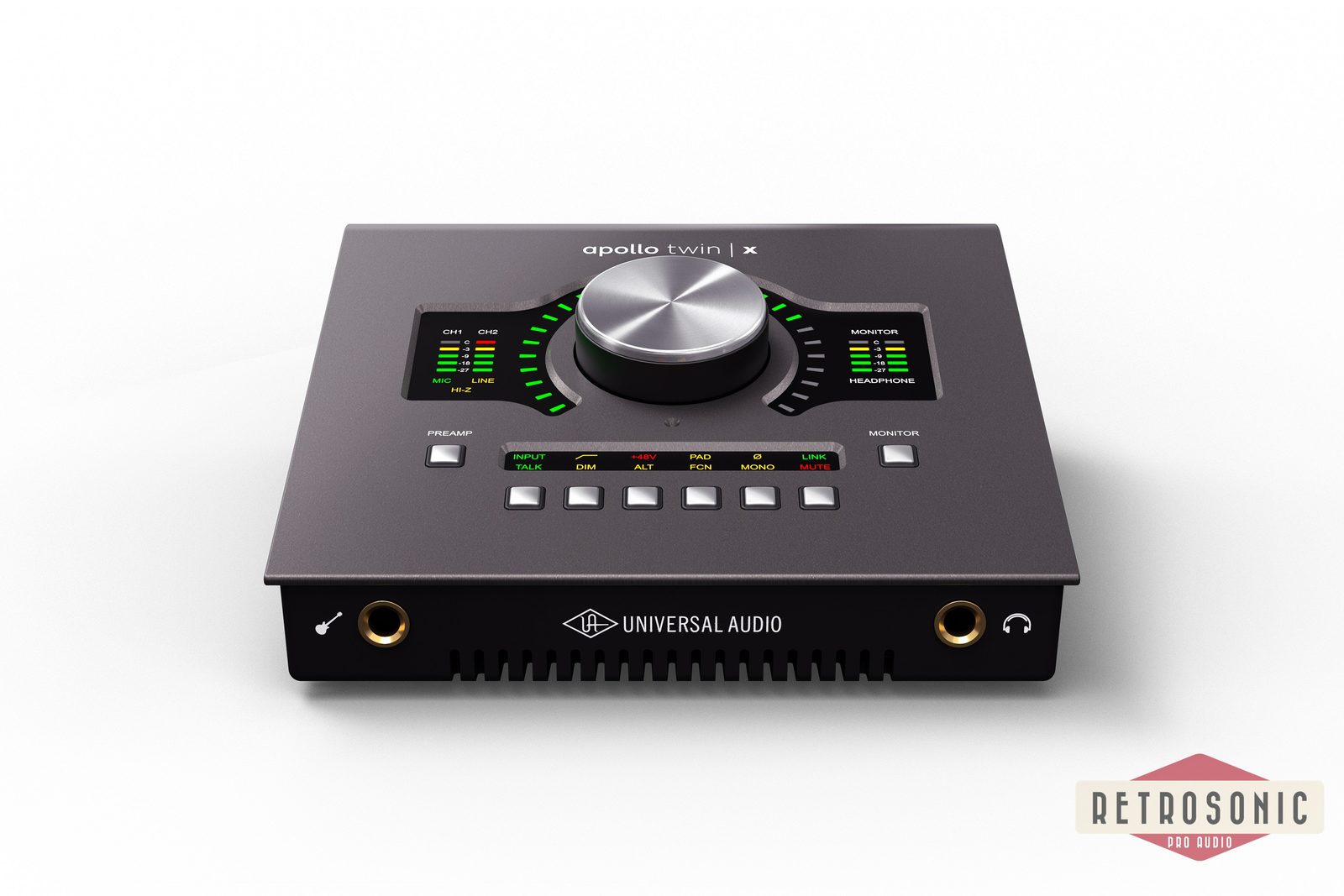
When you drop a grand on an interface, you expect a complete experience. Instead, you get a box that forces you to immediately head back to the store for a Thunderbolt 3 cable. As Audio University bluntly put it, "You'll notice that a Thunderbolt cable isn't included. I'll be honest, that's a bit of a slap in the face." Once you get past that initial annoyance, however, you’re holding a piece of hardware that feels like it could survive a drop from a second-story window. The all-metal chassis isn't just for show; it’s a functional heatsink that dissipates the energy of the internal DSP chips. It gets noticeably warm during long sessions, but that’s a small price to pay for the processing power tucked inside.
The real magic here isn't the raw conversion—though it is excellent—it’s the ecosystem. You aren't just buying an interface; you're buying into the UAD platform. The onboard DUO core processing allows you to run high-fidelity analog emulations while tracking, meaning you can hear that classic Neve preamp or LA-2A compression in your headphones with zero latency. As Home Studio Academy noted, "If you were to buy the actual hardware for some of the plugins... that will cost you tens if not hundreds of thousands."
Whether the raw preamp sound is "better" than a budget interface is a point of contention. If you’re looking for a night-and-day difference in clean gain, you might be disappointed. But if you’re looking for a professional workflow where you can commit to a sound before it hits your DAW, the Apollo Twin X is in a different league.
Sound — what reviewers actually heard
| Metric | Value | Context |
|---|---|---|
| Max Preamp Gain | 65 dB | Enough for an SM7B |
| Round-Trip Latency | 4.521 ms | Effectively imperceptible |
| Dynamic Range | 123 dBA | Industry-leading clarity |
| Max Resolution | 24-bit / 192 kHz | Studio standard |
Where it actually wins
The primary victory for the Apollo Twin X is the workflow. In a modern home studio, latency is the enemy of performance. When you’re tracking vocals or guitar, even a few milliseconds of delay can throw off your timing. The Apollo’s DSP handles the heavy lifting, allowing you to monitor through complex plugin chains without taxing your computer’s CPU. It’s a "set it and forget it" solution that lets you focus on the performance rather than buffer settings.
The build quality is another massive win. This is a device designed to live on a desk for a decade. The knobs have a tactile, weighted resistance that feels precise, and the front-panel controls are laid out logically, making it easy to adjust monitor levels or toggle phantom power without diving into software menus. It’s a professional tool that respects your time and your physical space.
Where it falls short
The biggest hurdle is the cost of entry and the "hidden" costs that follow. Beyond the missing cable, the UAD plugin ecosystem is a rabbit hole. The included Heritage bundle is a great start, but once you get a taste of the premium emulations, you’ll find yourself spending hundreds more to complete your collection. It’s a premium subscription-style trap disguised as a hardware purchase.
Furthermore, the heat management is a design choice that might worry some users. As Podcastage pointed out, "It has an all metal body which acts as a heat sink... it does get a little bit toasty." While it’s designed to handle the heat, it’s a constant reminder that you’re pushing a lot of processing power through a very small footprint. If you’re a beginner or someone who just wants to record a simple podcast, this is massive overkill. You’re paying for DSP power you likely won’t use, and you’d be better off with a simpler, cheaper interface.
Should you buy it?
Buy if you
- Are a serious producer or vocalist who needs zero-latency monitoring.
- Want to commit to a "finished" sound during the tracking phase.
- Value a robust, metal-chassis build that will last for years.
- Have the budget to invest in the UAD plugin ecosystem over time.
Skip if you
- Are a beginner or casual creator on a tight budget.
- Only need to record simple voiceovers or basic demos.
- Are frustrated by the idea of paying premium prices for hardware that doesn't include the necessary cables.
- Don't plan on using the UAD plugin platform.
A premium, DSP-powered powerhouse that delivers world-class analog emulations and zero-latency tracking, provided you can stomach the price.
Sources consulted
- Audio University — Focusrite Scarlett 2i2 vs UA Apollo Twin | Sound Quality Test & Comparison
- Audio University — Universal Audio Apollo Twin Audio Interface | Review, Setup, & Test
- Podcastage — Universal Audio Twin X Audio Interface Review / Explained
- Home Studio Academy — APOLLO TWIN X REVIEW: Is It Worth The Money?
Synthesis combines independent reviews above. Verdicts and quotes attributed to original creators. Affiliate disclosure: we may earn a commission from qualifying purchases via Amazon links.
Products covered in this review
Frequently Asked Questions
Is the Universal Audio Apollo Twin X DUO Heritage worth buying?
The Apollo Twin X DUO offers undeniable professional quality, robust build, and the massive advantage of onboard DSP to run UAD's industry-leading plugins without taxing your computer. However, the high entry price, expensive plugin ecosystem, and the frustrating omission of a Thunderbolt cable make it an investment that only makes sense for serious creators.
Who is the Universal Audio Apollo Twin X DUO Heritage best for?
Serious home studio producers and vocalists who want zero-latency tracking with premium analog gear emulations.
Who should skip it?
Beginners, casual podcasters, or musicians on a tight budget who would be better served by entry-level interfaces.