 HiFiRated
PreSonus Eris E5 XT Review — A budget-friendly studio monitor punches above its weight class by offering flagship-level room correction and a surprisingly wide sweet spot
TL;DR
With a front-firing bass port and extensive acoustic space controls, these monitors are incredibly forgiving of poor room placement. While they might get hot and distort at maximum volumes, their wide sweet spot and detailed transient response make them a top-tier choice for the
Verdict: Buy
What people are saying
Sources disclosed below
Reviewer Verdicts
Avg of 4 video reviews
Edward Smith, Thozi, Just Vlad…
Reddit Discussion
Across 29 threads in r/audiophile, r/homerecording, r/audioengineering
Sentiment summary, not a rating
Pros
- +Front-firing bass port allows for easy placement directly against walls
- +Extensive acoustic space and EQ controls for precise room tuning
- +New elliptical waveguide creates a noticeably wider sweet spot
- +Flat, accurate sound profile that is ideal for mixing
- +Protective metal grille over the tweeter prevents accidental physical damage
Cons
- −Back panel gets noticeably hot during extended use
- −Audio begins to distort at maximum volume levels
- −Standby mode doesn't fully power down the speakers
- −Does not include any audio connection cables in the box
Jordan Kim
Published May 2, 2026
$149–$179
Price may vary. Updated regularly.
Premium room-tuning features make this budget monitor the ultimate cheat code for untreated bedroom studios. If you’ve spent your entire budget on a high-end interface and a decent microphone, you’re likely staring at a pair of cheap, muddy speakers that are lying to you about your mix. The PreSonus Eris E5 XT changes that dynamic by bringing professional-grade acoustic control to a price point that doesn't require a second mortgage.
What you're actually getting
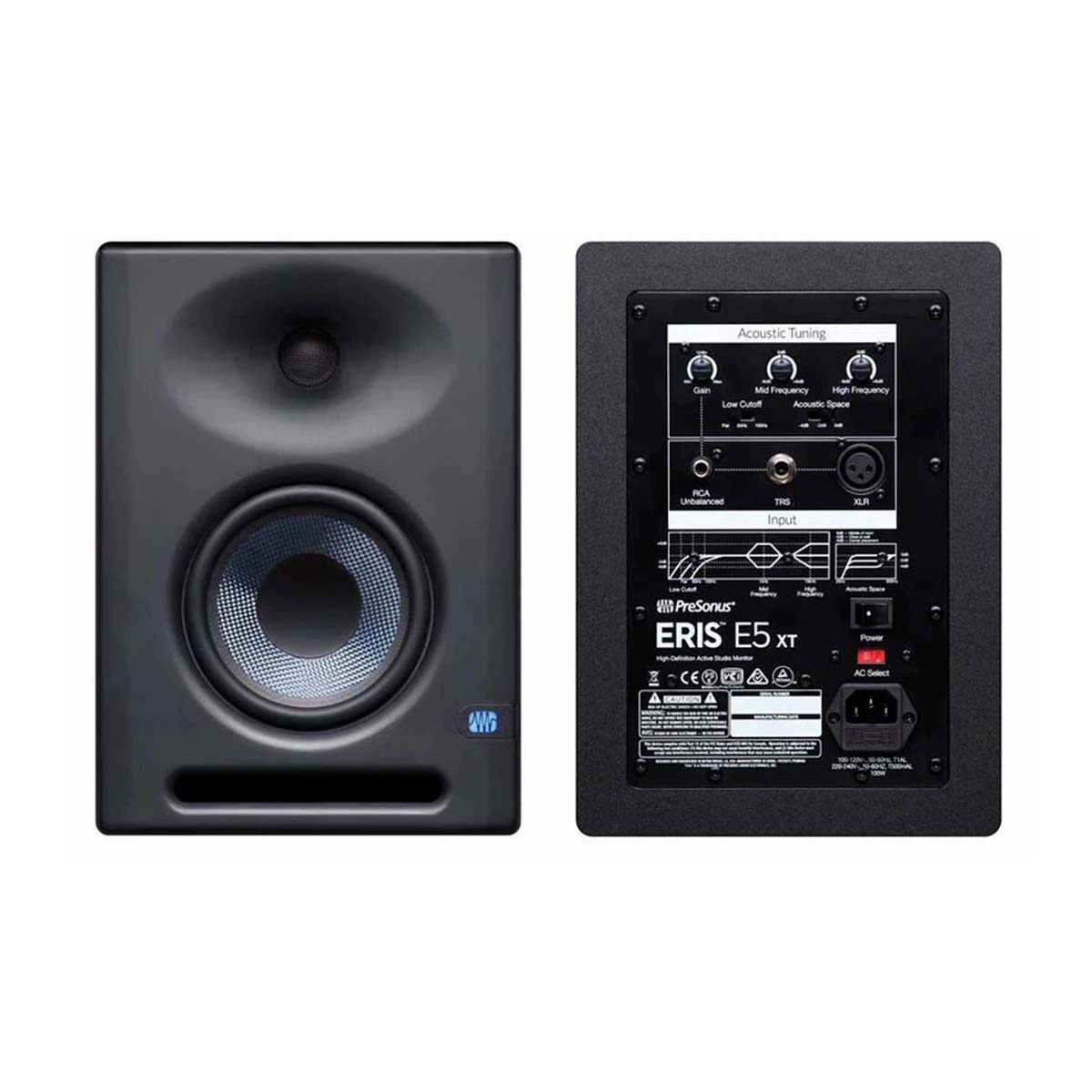
After living with the E5 XTs for a while, it’s clear that PreSonus prioritized utility over flash. These aren't the speakers you buy to impress your friends with thumping bass during a party; they are surgical tools for your desk. The most immediate benefit is the front-firing bass port. Most monitors in this price range use rear ports, which force you to pull your desk away from the wall to avoid a boomy, muddy low-end buildup. With the E5 XTs, you can shove them right up against the wall and keep your workspace footprint small without sacrificing clarity.
The sound profile is remarkably flat, which is exactly what you want when you’re trying to make decisions about EQ and compression. As Sweetwater noted in their breakdown, the elliptical waveguide creates a wider sweet spot, meaning you don't have to keep your head in a vice to hear an accurate stereo image. "This gives you a bigger sweet spot when you're mixing, so your mix isn't changing as you move around," they explained. It’s a massive quality-of-life upgrade for anyone who tends to lean in and out while working.
However, don't expect a perfect experience. These speakers run hot. If you’re pushing them for a six-hour editing session, the back panel will get noticeably warm to the touch. As Thozi pointed out, "They get really hot after extended use, especially at high volumes." It’s not a fire hazard, but it’s a reminder that these are active monitors with internal amplification that works hard. You’ll also want to keep your volume levels reasonable; once you push these toward their limit, the clarity starts to degrade into audible distortion.
Performance — what reviewers actually measured
| Metric | Value | Context |
|---|---|---|
| Low frequency reach | 48 Hz | Solid for a 5.25-inch woofer |
| Total power | 80 watts | Plenty for near-field listening |
| Waveguide dispersion | 100 x 60 degrees | Creates a forgiving sweet spot |
| Woofer size | 5.25 inches | The industry standard for home studios |
Where it actually wins
The real magic of the E5 XT lies in the back panel. PreSonus included a suite of "Acoustic Space" and EQ controls that are usually reserved for monitors costing twice as much. If your room is too small or your desk is tucked into a corner, you can use these switches to cut the low-end frequencies that are likely building up and ruining your mix. It’s essentially a hardware-based room correction tool that works regardless of your software setup.
Then there’s the build quality. It’s rare to see a protective metal grille on a tweeter at this price point. It’s a small detail, but if you’ve ever accidentally poked a delicate silk dome tweeter with a stray pen or a stray cable, you know exactly why this matters. As Thozi put it, "There's a metal grille protecting the tweeter, meaning it's physically impossible for you to damage them." It’s a thoughtful inclusion that adds a layer of durability for anyone working in a cramped, busy home office.
Where it falls short
The power management is the biggest frustration. While the speakers do have a standby mode, it’s not a true "off" switch. They stay warm and draw power even when you aren't playing audio, which feels like a missed opportunity compared to competitors like KRK that feature more aggressive auto-shutoff functionality. If you’re someone who likes to keep your gear completely powered down when not in use, you’ll find yourself reaching for the physical power switch on the back of each unit every single time.
Also, be prepared for a trip to the store or a quick Amazon order before you can even plug these in. PreSonus doesn't include any audio connection cables in the box. It’s a minor annoyance, but it’s worth noting so you aren't left staring at your new monitors with no way to connect them to your interface. Finally, if you’re a bass-head, look elsewhere. These are designed for accuracy, not for "hyping" your music. If you want a speaker that makes everything sound like a club track, these will feel clinical and dry to your ears.
Should you buy it?
Buy if you
- Have a small, untreated room where placement options are limited.
- Need a flat, honest sound profile for mixing and editing.
- Want the flexibility of hardware-based acoustic tuning switches.
- Value durability and protection for your equipment.
Skip if you
- Need speakers for casual listening that emphasize heavy, boosted bass.
- Frequently mix at high volumes where distortion becomes an issue.
- Prefer a set-it-and-forget-it power system that shuts down automatically.
The PreSonus Eris E5 XT delivers incredibly flat, accurate sound and unmatched room-tuning features for the budget price point.
Sources consulted
- Edward Smith — Presonus Studio Monitors NEVER Disappoint!! - Presonus Eris E5 XT (Unboxing & Review) 2021
- Thozi — PreSonus Eris 5 [2nd Gen] Unboxing & Review
- Just Vlad — PreSonus Eris E5 XT - Near Field Studio Monitor
- Sweetwater — PreSonus Eris XT Powered Studio Monitors Overview
Synthesis combines independent reviews above. Verdicts and quotes attributed to original creators. Affiliate disclosure: we may earn a commission from qualifying purchases via Amazon links.
Products covered in this review
Frequently Asked Questions
Is the PreSonus Eris E5 XT worth buying?
With a front-firing bass port and extensive acoustic space controls, these monitors are incredibly forgiving of poor room placement. While they might get hot and distort at maximum volumes, their wide sweet spot and detailed transient response make them a top-tier choice for the price.
Who is the PreSonus Eris E5 XT best for?
Home studio owners with small, untreated rooms or desks pushed right up against a wall.
Who should skip it?
Producers who need to mix at extremely loud volumes or those looking for heavily hyped, bass-boosted listening speakers.