 HiFiRated
KRK Rokit 5 G4 Review — A misunderstood studio staple sheds its amateur, bass-heavy stereotype to deliver genuinely professional, flat-response monitoring on a budget
TL;DR
Thanks to stiff Kevlar drivers and an innovative rear LCD for precise EQ adjustments, these monitors offer serious accuracy for the price. While the companion app is a gimmick, the hardware itself provides incredible value and controlled low-end for home studio producers.
Verdict: Buy
What people are saying
Sources disclosed below
Reviewer Verdicts
Avg of 4 video reviews
Tech Steve, AudioHaze, Edward Smith…
Reddit Discussion
Across 50 threads in r/audiophile, r/homerecording, r/audioengineering
Sentiment summary, not a rating
Pros
- +Kevlar drivers (woofer and tweeter) provide stiff, controlled, and accurate sound reproduction
- +Front-firing bass ports allow for easier placement near walls in small rooms
- +Built-in rear LCD screen offers extensive DSP room tuning and precise volume control
- +Combo XLR/TRS inputs provide versatile balanced connection options
- +Excellent overall value and build quality for the budget price point
Cons
- −The companion smartphone app is glitchy, poorly designed, and relies on inaccurate phone microphones
- −Requires specific balanced cables or an audio interface, which might confuse beginners looking for computer speakers
- −The aesthetic redesign is polarizing, with some missing the brighter yellow and shape of previous generations
Jordan Kim
Published May 2, 2026
$199–$229
Price may vary. Updated regularly.
Forget everything you thought you knew about KRK's bass-heavy reputation—the G4s are shockingly flat and precise. For years, the brand was unfairly pigeonholed as the "club speaker" for bedroom producers who wanted their tracks to rattle the windows rather than sound accurate. The G4 generation effectively kills that stereotype, proving that you don't need to spend a month's rent to get a professional-grade monitoring experience.
What you're actually getting
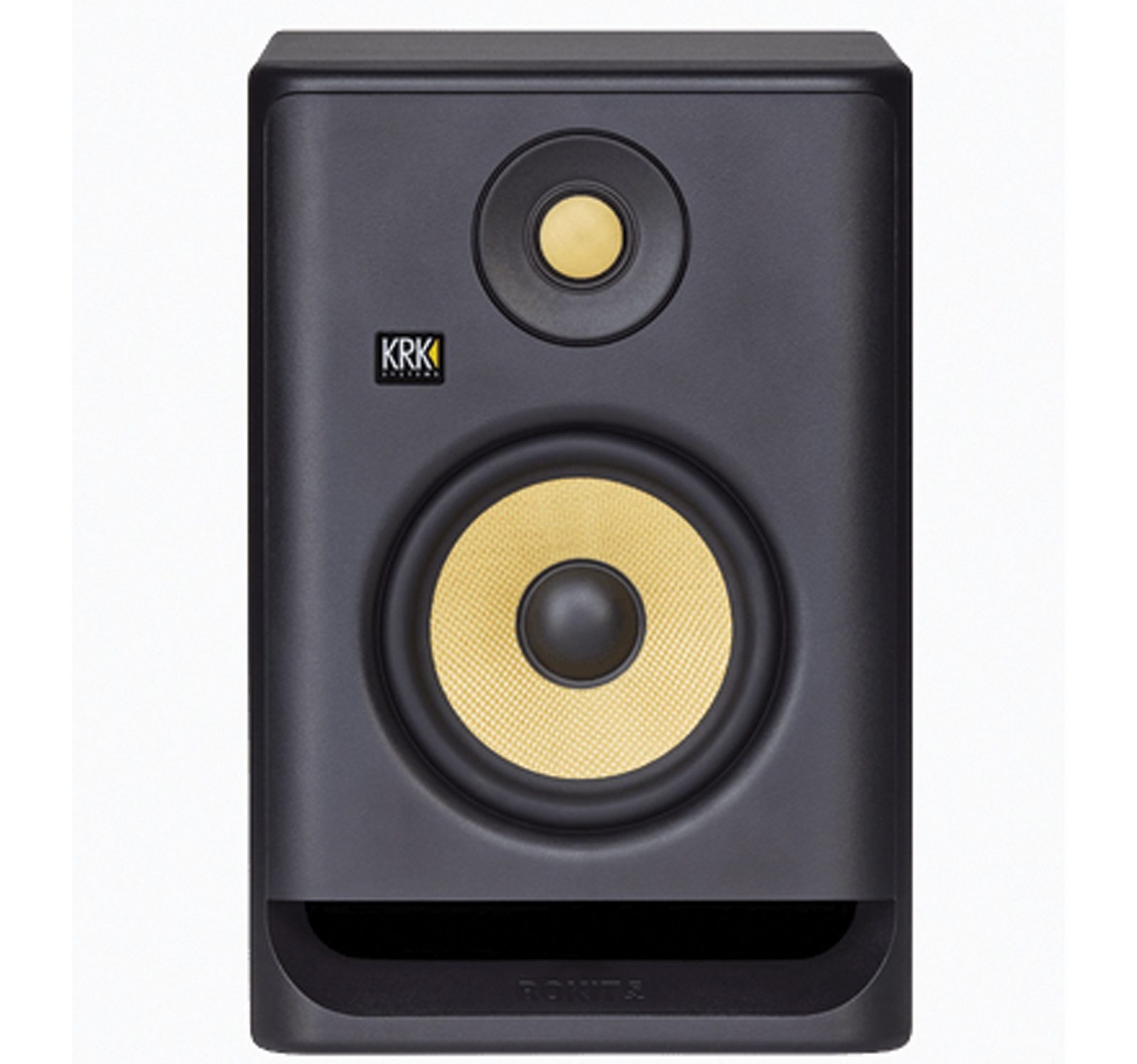
When you unbox the Rokit 5 G4, you aren't just getting a pair of speakers; you're getting a surgical tool for your desk. The shift to matching Kevlar drivers for both the woofer and the tweeter is the secret sauce here. It creates a stiff, incredibly fast response that makes transient details—like the snap of a snare or the pluck of a bass string—pop with a clarity that cheaper paper-cone speakers simply can't touch. As AudioHaze noted, "There's a false belief that these are bass boosted when in fact that could not be further from the truth."
The real game-changer, however, is the rear-mounted LCD screen. In a world where most budget monitors force you to fiddle with tiny, imprecise knobs on the back, KRK gives you granular control over your room EQ and volume in 0.1 dB increments. It’s a level of precision that feels like it belongs on gear costing three times as much. Edward Smith hit the nail on the head when he said, "This LED screen is an amazing addition, it's one of the key things KRK has done to step up."
If you’re used to standard computer speakers, be prepared for a reality check. These are active studio monitors, meaning they require balanced XLR or TRS cables and an audio interface. They aren't "plug-and-play" in the sense that you can just jam a 3.5mm jack into your laptop. But once you get them dialed in, the front-firing bass port makes them surprisingly forgiving. You can place them closer to a wall than most rear-ported monitors without turning your low-end into a muddy, boomy mess.
Performance — what reviewers actually measured
| Metric | Value | Context |
|---|---|---|
| Frequency Response | 43 Hz to 40 kHz | Extremely wide for a 5-inch woofer |
| Bass Roll-off | Tapers at 50Hz | Solid low-end, but needs a sub for sub-bass |
| Volume Control | 0.1 dB steps | Highly precise via rear LCD |
| Real-world Price | ~$360 per pair | Exceptional value for the build |
Where it actually wins
The standout feature is undoubtedly the DSP room tuning. Most home offices are acoustic nightmares, filled with hard surfaces and weird corners that cause standing waves. The G4’s onboard EQ allows you to compensate for these room anomalies directly on the speaker. You don't need to buy expensive third-party software or external hardware to get a flatter response in your specific workspace.
Furthermore, the build quality is tank-like. These things feel dense and substantial, which is exactly what you want to prevent cabinet resonance from coloring your sound. The front-firing port is a massive win for anyone working in a smaller room. It allows for a tighter, more punchy bass response that doesn't rely on the wall behind the speaker to "load" the sound, giving you a much more predictable monitoring environment.
Where it falls short
While the hardware is stellar, the software experience is a total disaster. KRK’s companion app is widely considered a gimmick—it’s glitchy, unintuitive, and relies on your phone’s microphone to "tune" your room, which is scientifically laughable compared to using a calibrated measurement mic. Do yourself a favor: ignore the app entirely and use your ears or a proper measurement tool to set your EQ via the physical LCD screen.
The aesthetic redesign is also a point of contention. If you loved the iconic, bright yellow cones of the G3s, the more muted, professional look of the G4 might feel a bit sterile. Some users find the new design a bit "corporate," though the pulsing backlit logo is a nice touch for those who like a bit of flair in their studio. Finally, if you are a total beginner, the requirement for balanced cables and an audio interface is a hurdle. If you just want to watch YouTube videos, these are overkill and will likely frustrate you with their connectivity requirements.
Should you buy it?
Buy if you
- Are a producer or beatmaker who needs an honest, flat sound to make mixing decisions.
- Work in a small room and need front-ported speakers that won't boom against the wall.
- Value precise, repeatable volume and EQ settings via a physical interface.
Skip if you
- Want a simple plug-and-play setup for gaming or casual music listening.
- Are looking for a "vibe" speaker that artificially boosts bass for a fun listening experience.
- Expect the companion app to do the heavy lifting for your room acoustics.
The KRK Rokit 5 G4 sheds its bass-heavy reputation, delivering a surprisingly flat, controlled sound with class-leading DSP room tuning.
Sources consulted
- Tech Steve — KRK ROKIT 5 Studio Monitors Overview and Audio Demo
- AudioHaze — KRK Rokit 5 G4 Review - These Monitors Are Severely Misunderstood (Budget Studio Monitors Review)
- Edward Smith — These Studio Monitors are ALMOST PERFECT!! || KRK Rokit 5 G4 Studio Monitor (Unboxing & Review)
- Edward Smith — Should you buy KRK Studio Monitors in 2025?
Synthesis combines independent reviews above. Verdicts and quotes attributed to original creators. Affiliate disclosure: we may earn a commission from qualifying purchases via Amazon links.
Products covered in this review
Frequently Asked Questions
Is the KRK Rokit 5 G4 worth buying?
Thanks to stiff Kevlar drivers and an innovative rear LCD for precise EQ adjustments, these monitors offer serious accuracy for the price. While the companion app is a gimmick, the hardware itself provides incredible value and controlled low-end for home studio producers.
Who is the KRK Rokit 5 G4 best for?
Home studio producers and beatmakers looking for accurate, room-tunable monitors on a budget.
Who should skip it?
Casual listeners wanting plug-and-play computer speakers or those who rely heavily on automated app-based room correction.